Tadzio
Death in VeniceTadzio is a Polish boy staying at the hotel with his sisters and their governess, whose beauty becomes the central object of Gustav von Aschenbach’s attention in Venice. The story presents him largely through Aschenbach’s gaze: at once a particular child among other holidaymakers and an idealized image that the writer associates with classical form, myth, and beauty. Tadzio’s actions remain distinct from the meanings Aschenbach projects onto them, a distance that shapes the tragedy of their one-sided connection.
Identity and First Appearance
Aschenbach first notices Tadzio in the hotel lobby, where he sits with three sisters around a small wicker table under the care of a governess. About fourteen, long-haired and dressed in an English sailor suit, he has pale skin, honey-coloured curls, a straight nose, and a composed expression. Aschenbach compares his appearance to Greek sculpture and finds in it a combination of formal perfection and personal charm that he has not encountered elsewhere.
The contrast with Tadzio’s sisters sharpens this first impression. Their slate-coloured, deliberately severe clothes and tightly brushed hair suggest an upbringing governed by restraint; Tadzio, by contrast, appears to have been treated with gentleness and tenderness. His curls are left long, and his sailor suit gives his slender figure a more luxurious appearance. Aschenbach wonders whether his pallor signals illness, but inclines instead to the possibility that he is a pampered favourite child. These explanations are Aschenbach’s impressions, not confirmed facts about Tadzio’s health or family life.
Life at the Hotel and on the Beach
Tadzio’s name reaches Aschenbach through the sounds of play around the sand structures on the beach. The boy works with a group of about ten children, directing a task involving a plank laid across the moat of a sandcastle. The others call for him often; he is evidently in demand among them. A Polish boy called Jaschu appears to be his closest companion. When the children pause from building, the two walk arm in arm, and Jaschu kisses him.
Aschenbach puzzles over the name he hears as “Adgio.” Drawing on fragmentary recollections of Polish, he identifies it as Tadzio, a shortened form of Tadeusz, also heard as Tadziu when called. The moment gives Aschenbach’s attention a new focus: even the boy’s name becomes an object of close listening and interpretation.
Later, Aschenbach sees Tadzio swimming far from the bathing houses. Women call him back by name, their calls carrying across the beach as he turns and swims toward shore. As Tadzio emerges from the water, Aschenbach interprets the sight through images of myth and divine origins, imagining the appearance of a godlike figure rising from the elements. The passage reveals less about Tadzio’s inner life than about the increasingly imaginative lens through which Aschenbach watches him.
The Smile and Aschenbach’s Projection
One evening, after noticing that Tadzio and the other Polish children were absent from dinner, Aschenbach sees them return with their governess. Tadzio wears a dark-blue sailor overcoat and matching cap. Their eyes meet, and Tadzio smiles at him. The narrative describes the smile through the image of Narcissus looking at his reflection; that comparison belongs to the story’s portrayal of the moment, not to evidence that Tadzio intends a particular message for Aschenbach.
Aschenbach leaves the terrace in an unsettled state and retreats into the park. He experiences the smile as a momentous personal gift and whispers that he loves Tadzio. The episode marks the widening gap between what can be observed—a brief smile—and the emotional significance Aschenbach assigns to it. Tadzio’s part in the encounter is slight and ambiguous; its force comes chiefly from the older man’s response.
Final Appearance and Narrative Significance
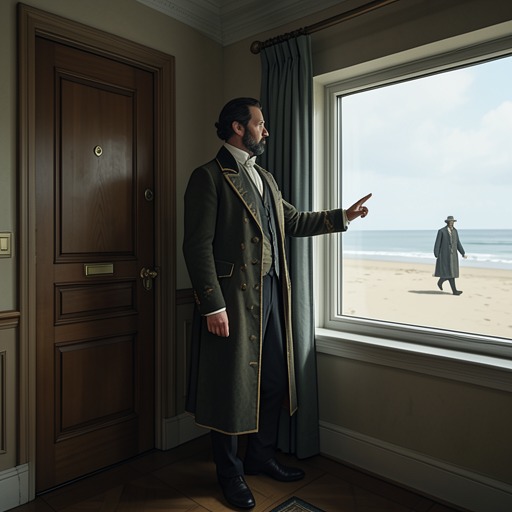
Near the end, Tadzio moves through the shallows to a sandbank, separated by water from the mainland and by his mood from his companions. He pauses, looks out to sea, then turns to look back toward shore. Aschenbach, watching from his chair, reads the glance as a smile and a beckoning gesture, although the scene presents this as his impression rather than a confirmed intention on Tadzio’s part. Once again, he rises as if to follow.
Aschenbach collapses in his chair and is taken to his room; his death is announced later that day. Tadzio neither explains nor witnesses the outcome in the account given here. His final look instead completes the pattern through which the story has represented him: he remains a boy whose ordinary gestures acquire immense symbolic weight in Aschenbach’s imagination. Beauty, in this portrayal, draws the writer toward an ideal, but the distance between the living person and the idealized image remains unresolved.